Are You Earning Up to Your Potential?
Most personal trainers are undervaluing their time and skills. Our Personal trainer Revenue Calculator helps you find out what you should be making, and how to get there.
No guesswork. Just real numbers.
.webp)
TL;DR:
Calculate BMR with the Mifflin-St Jeor equation, which the Academy of Nutrition and Dietetics and the American Council on Exercise both recommend. For a 35-year-old woman at 70 kg and 165 cm, it gives 1,395 calories a day. Both versions of the older Harris-Benedict formula return figures around 4 to 5% higher, and nobody should eat below their BMR.
Most guides to calculating BMR hand you a formula and stop. The formula they usually hand you is the older Harris-Benedict equation; it runs high, and nothing tells you so.
This guide covers the equation to use, how to run it in metric and imperial, a full worked example, what changes BMR, and where every estimate becomes unreliable. It is written for coaches setting targets for clients, though the arithmetic is identical whether you are running it for one person or a whole roster.
What is BMR?
BMR, or basal metabolic rate, is the minimum number of calories your body needs to function at rest. That covers breathing, circulation, body temperature and cell repair, with no movement, digestion or exercise included.
It is the largest part of daily energy use. Cleveland Clinic puts it at 60 to 70% of the total energy the body uses, with roughly 10% going to digesting food and the rest to movement.
There is no single normal figure. Cleveland Clinic gives averages of around 1,696 calories a day for men and 1,410 for women, while stressing that BMR is individual.
You will also see RMR, resting metabolic rate. RMR allows for low-effort activity like getting dressed and runs about 10% higher than BMR, but the two terms are used interchangeably, and the equations below estimate both.
How is BMR calculated?
Either by measuring it in a lab or by estimating it with an equation that uses weight, height, age, and sex.
Lab measurement comes in two forms. Direct calorimetry measures heat output while you rest in a sealed chamber; it is the most accurate method and is almost entirely limited to research. Indirect calorimetry measures oxygen use and carbon dioxide output with an in-office device, which is more accessible though still rarely available outside clinics.
For everyone else, prediction equations work. Three cover almost every situation
Use Mifflin-St Jeor unless you have a specific reason not to. The Academy of Nutrition and Dietetics recommends it as the most accurate estimate when metabolic rate cannot be measured directly, and the American Council on Exercise takes the same position.
💪 Got an idea for a brand? Let's bring it to life.
Launch your own fitness app with FitBudd in minutes!

💪 Got your brand name? Let’s bring it to life.
Launch your own fitness app with FitBudd in minutes!



88% trainers worldwide gave us 5 stars
Transform your fitness business with the power of your branded app on iOS and Android.
Try for FREEHow to calculate BMR with the Mifflin-St Jeor equation
The equation takes four inputs and one constant that differs by sex. That constant is the only difference between the male and female versions.
What is the Mifflin-St Jeor formula in metric?
Use weight in kilograms, height in centimeters, and age in years.
The Academy's published version uses slightly more precise coefficients of 9.99, 6.25 and 4.92. The rounded version above produces results within a few calories, well within the equation's error.
What is the Mifflin-St Jeor formula in imperial?
Use weight in pounds and height in inches. The coefficients change because the units change, but the result is the same.
The imperial coefficients come straight from the metric ones: 10 multiplied by 0.4536, the kilograms in a pound, and 6.25 multiplied by 2.54, the centimeters in an inch. Convert height to inches first, so five feet five inches becomes 65.
How to calculate your BMR: a worked example
Take a 35-year-old woman who weighs 70 kg and is 165 cm tall.
Run the same woman through the imperial version at 154.3 pounds and 65 inches and you get 1,396, within a calorie of the metric result. That agreement is a useful check whenever you convert units.
For a client who thinks in imperial from the start, say 150 pounds, 5 feet 5 inches and 35 years old:
- Weight: 4.536 x 150 = 680.4
- Height: 15.875 x 65 = 1,031.9
- Age: 5 x 35 = 175
- BMR: 680.4 + 1,031.9 - 175 - 161 = 1,376 calories a day
How to calculate BMR for women
Use the same formula as for men, then subtract 161 instead of adding 5.
That 166-calorie gap reflects average differences in body composition. Men generally carry more lean muscle, which burns more energy at rest than fat does. It is an average, not a rule.
For a woman who is very lean or carries more muscle than typical, Mifflin-St Jeor tends to underestimate. Katch-McArdle is the same.
How does Mifflin-St Jeor compare with Harris-Benedict?
Mifflin-St Jeor is more accurate for most adults, and both versions of Harris-Benedict run high.
This is worth being precise about because two Harris-Benedict equations are in circulation, and sources quote different ones. The original was published in 1919. Roza and Shizgal revised it in 1984, and Cleveland Clinic uses that version

How much more accurate is it?
Considerably more than most guides suggest, and the gap widens in the population where it matters most.
The Academy of Nutrition and Dietetics Evidence Analysis Library reports that Mifflin-St Jeor predicted RMR within 10% of measured RMR in 70% of obese individuals, across nine cross-sectional studies. Harris-Benedict, using actual weight, managed that in 39 to 64% of obese individuals, across eleven studies. In non-obese adults, Frankenfield's systematic review found Mifflin-St Jeor within 10% for roughly 82%.
So the difference isn't just a few percentage points. In obese clients, Harris-Benedict can be wrong by more than 10% in over half of cases, whereas Mifflin-St Jeor is wrong that badly in under a third.
Seventy calories sounds small. Carried through an activity multiplier and held across a twelve-week fat-loss phase, it separates a deficit that works from one that quietly does not. And the older, heavier, more sedentary clients most likely to be dieting are the ones where the two equations diverge most.
If a guide gives you a BMR formula starting with 66 or 88 for men, or 655 or 447 for women, it is one of the two Harris-Benedict versions.
When should you use Katch-McArdle instead?
Use Katch-McArdle when you know a client's body fat percentage, and they are noticeably leaner or more muscular than average.
Mifflin-St Jeor and Harris-Benedict estimate from total weight, so they cannot tell 80 kg of mostly muscle from 80 kg with more fat. Katch-McArdle uses lean body mass directly, which removes that blind spot.
- Lean body mass = weight x (1 - body fat percentage)
- BMR = 370 + (21.6 x lean body mass in kg)
For a 70 kg client at 30% body fat, lean body mass is 49 kg, and BMR is 370 + (21.6 x 49) = 1,428 calories/day.
The catch is the body fat figure. Katch-McArdle is only as accurate as the measurement feeding it, and a poor estimate produces a worse result than simply using Mifflin-St Jeor.
How do you calculate BMR by hand, step by step?
Five steps, no matter which equation you use.
- Measure weight and height in consistent units, metric or imperial, never mixed.
- Record age in whole years.
- Choose the equation. Mifflin-St Jeor by default, Katch-McArdle with a reliable body fat reading.
- Run the formula in the order written: multiply first, then add and subtract.
- Sense-check the result. Most adults land between roughly 1,200 and 2,200 calories. A figure far outside that usually means a unit error.
An online calculator runs exactly this arithmetic. Doing it by hand once is worth the five minutes, because it shows you which input is moving the number when a client's figure looks wrong.
What factors affect your BMR?
Body size, muscle mass, age, sex, and genetics set most of it, and several temporary conditions push it up or down. No equation captures all of these, which is part of why every estimate needs correcting against real progress.
Largely fixed:
- Body size. More tissue means more energy needed to maintain it.
- Muscle mass. Muscle costs more energy to maintain than fat, so more muscle means a higher BMR.
- Age. BMR falls as muscle is lost, by roughly 1 to 2% per decade, according to Forbes Health.
- Sex. Men generally have a higher BMR, mainly because they tend to be larger and carry more lean mass.
- Genetics and ethnicity. Both appear to play a role, and researchers are still studying how much.
Temporary shifts:
- Eating too little. Prolonged restriction slows BMR as the body protects itself, covered further down.
- Thyroid hormone. An overactive thyroid raises BMR and an underactive one lowers it.
- Illness or injury. BMR rises while the body fights infection or repairs tissue.
- Stimulants. Caffeine and nicotine can raise it.
- Extreme temperatures. Working to stay warm or cool increases energy use.
Life stages:
- Pregnancy raises BMR as body mass increases and a fetus grows.
- Breastfeeding increases energy expenditure by around 15 to 25% for milk production, according to Cleveland Clinic.
- Menopause tends to lower BMR as hormonal changes reduce lean mass.
For coaching, the thyroid point matters most. A client whose weight will not move despite consistent intake and training may need screening, and that is a referral rather than a programming problem.
How do you turn BMR into daily calories?
Multiply BMR by an activity factor. The result is total daily energy expenditure, or TDEE, which is what calorie targets are actually built from. A TDEE calculator performs this step, and it is where most of the practical judgment sits.
For the worked example at lightly active: 1,395 x 1.375 = 1,918 calories a day to maintain her weight.
Most people overestimate their activity level. Someone who trains three times a week but sits for ten hours a day is closer to lightly active than moderately active, so choose the lower multiplier when in doubt.
How do you set a calorie target for fat loss or muscle gain?
Adjust TDEE by around 10 to 20% in the direction of the goal.
- Fat loss: subtract 15% as a starting point. For the example client, 1,918 x 0.85 = 1,630 calories a day.
- Muscle gain: add 10 to 15%, with a smaller surplus for clients who want to limit fat gain.
- Maintenance: use TDEE as it stands.
That 15% is a starting estimate, not a prescription. The real target emerges from two to four weeks of tracking weight against intake, and the same logic applies in reverse when building a surplus into a meal plan.
Should you ever eat below your BMR?
No. BMR is the energy needed to keep the body running at rest, and eating below it regularly is unsafe and unsustainable.
Notice that the fat-loss target above, 1,630 calories, still sits comfortably above her BMR of 1,395. That is the correct shape. A deficit comes from the gap between intake and TDEE, not from undercutting BMR.
Cutting too deep backfires. The body responds to prolonged severe restriction by slowing its metabolic rate, which makes further loss harder and weight regain more likely. A small to moderate deficit works better than a large one.
For coaches, there is one more reason to be careful. Calorie counting and exercise tracking have been associated with disordered eating in some people. If a client becomes preoccupied with numbers, feels guilt around food, or keeps pushing intake lower, that signals the need to involve a registered dietitian rather than tighten the plan. The dos and don'ts of nutrition coaching cover where that line sits.
How do you set macros from a BMR calculation?
Set protein first, by bodyweight, then divide the remaining calories between carbohydrate and fat.
Fixed percentage splits, such as 40% protein, 30% carbohydrate and 30% fat, are common but scale badly. With a large client, they push protein far higher than necessary, and with a small client, they leave it too low.
A more reliable order:
- Protein: many coaches set roughly 1.6 to 2.2 g per kg of bodyweight, which is about 112 to 154 g a day for a 70 kg client.
- Fat: set a floor, commonly around 20 to 30% of total calories, to support hormonal health.
- Carbohydrate: fill whatever calories remain.
Any nutrition coaching app will do this arithmetic automatically, but the order matters more than the tool. Start with protein by bodyweight, and the rest follows.
Can you increase your BMR?
Somewhat, and the most reliable way is building muscle.
Age, height, and genetics cannot be changed. Muscle mass can, and because muscle costs more energy to maintain than fat, adding lean mass raises BMR. Resistance training is the main lever, which is one of the strongest arguments for putting strength work into every client's program.
This also explains why BMR does not always fall with weight loss. A client who loses weight through restriction alone tends to lose some muscle, and BMR drops with it. A client who loses fat while building or holding muscle may lose weight more slowly but keep a higher BMR, which makes the result easier to maintain.
That difference is worth explaining to clients early. A slower scale is often a better outcome than a faster one.
How accurate is a BMR calculation?
Accurate enough to start from, and never accurate enough to stop adjusting.
Mifflin-St Jeor lands within about 10% of measured BMR for roughly four in five non-obese adults, which means about one in five falls outside that range. Even the best equation is an estimate.
Four situations make every BMR estimate less reliable:
- Higher BMI. Accuracy drops for all equations as BMI rises past roughly 35 to 40, and research separating obese from non-obese subjects is limited.
- Ethnicity. The Academy notes Mifflin-St Jeor was developed on a predominantly white sample and may be less accurate for other groups.
- Body composition outliers. Very lean or very muscular clients can skew weight-based equations, as with Katch-McArdle.
- Metabolic adaptation. After a long diet, actual expenditure can fall below what any equation predicts.
The conclusion is the same in every case. Use the equation to set the starting point, then let two to four weeks of real progress tell you whether it was right.
How do coaches calculate BMR for every client?
By hand for the first few, and with software once the roster grows.
Running Mifflin-St Jeor, an activity multiplier, a goal adjustment, and a macro split takes a few minutes per client. The problem is that it needs redoing whenever weight changes, and across thirty clients that becomes recurring admin rather than a one-off.
Accuracy also depends on the inputs. Age, weight, height, activity, and goal all have to come from somewhere, which is why a structured client intake and assessment process matters before any calculation does.
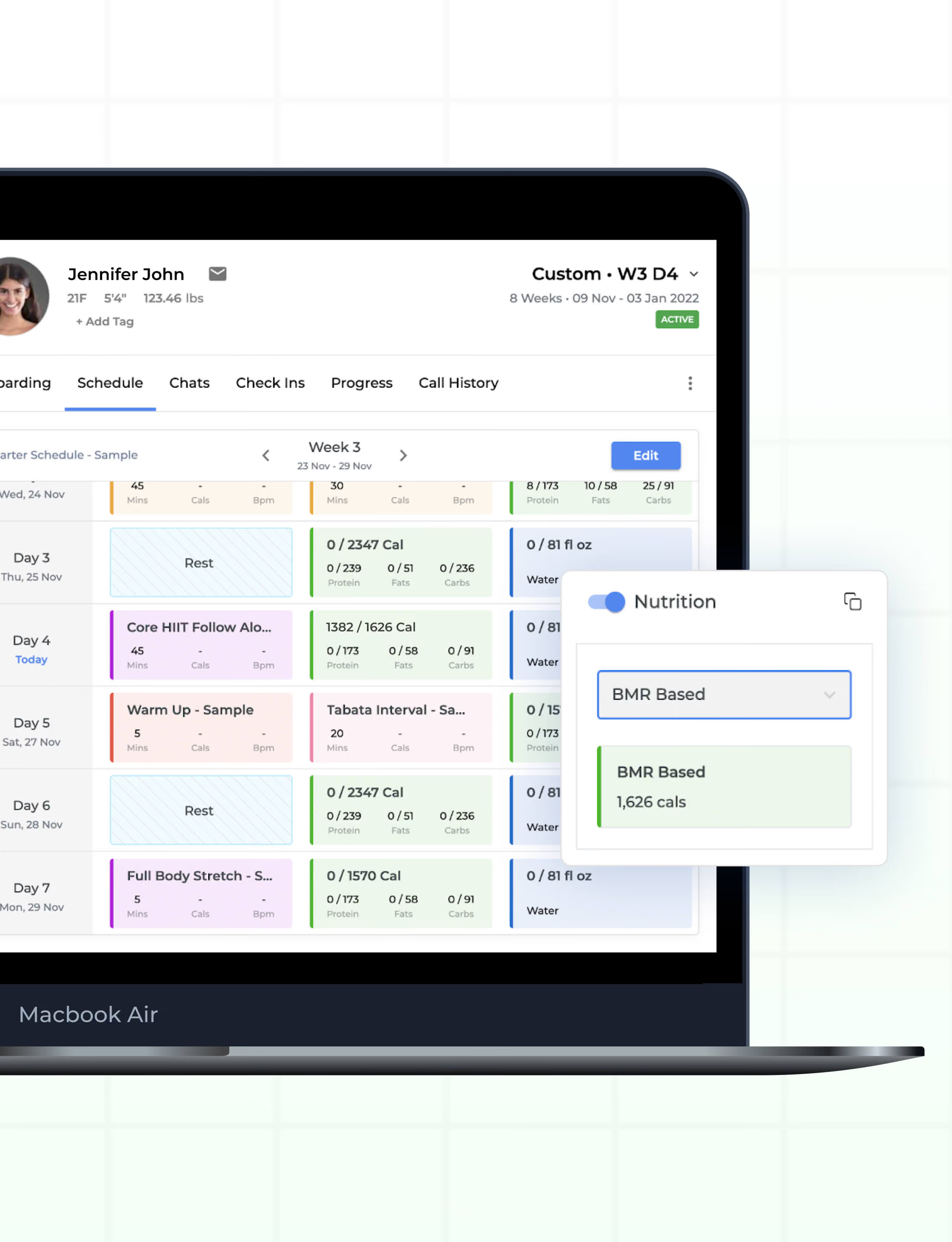
This is where nutrition coaching software earns its place. FitBudd calculates BMR from a client's onboarding answers, recalculates it as their weight changes, and then generates a macro-based meal plan from the result. The value is not the arithmetic, which is simple, but keeping thirty calculations current without doing each one by hand.
Calculate one client's BMR today
Pick one client and run the full sequence by hand: Mifflin-St Jeor, an honest activity multiplier, a 15% adjustment toward their goal, and protein set by bodyweight.
Check that the calorie target sits above their BMR. Then write the number down and compare it against their actual weight trend in two weeks, which will teach you more about how these equations fit your clients than any formula.
If the number is off, adjust the target, not the method. The equation gets you close. Tracking gets you right.
Once that sequence is working for one client, the only question left is how to keep it current for thirty. Book a demo, and we will set up automatic recalculation from your intake form.


Meet the author
Kinshuk Snehi
Kinshuk Snehi, FitBudd's digital maestro, weaves marketing magic and leverages his deep understanding of FitBudd to empower personal trainers.
Frequently Asked Questions

Yangzey Sherpa leads content strategy at FitBudd, overseeing content planning and execution across fitness-focused digital channels. With over five years of experience in SEO and content, she works closely with the fitness industry to ensure content aligns with the needs of coaches, trainers, and gym owners. Her role keeps her deeply connected to fitness business workflows, coaching models, and how professionals use digital platforms to grow.


Apra Pathak has worked closely within the fitness niche for several years, supporting personal trainers and fitness coaches through content and digital marketing initiatives. Her experience centers on understanding how fitness professionals build visibility, communicate value, and engage clients online. Through sustained involvement with fitness-focused platforms and audiences, she has developed a strong understanding of the digital needs and growth challenges faced by modern fitness businesses.

Aishwarya Mehra has been actively involved in fitness-focused digital marketing, working closely with brands and platforms that serve coaches, trainers, and fitness businesses. Her experience spans engagement-driven strategies designed specifically for fitness audiences. Through ongoing exposure to fitness campaigns and communities, she remains closely aligned with how fitness professionals attract, convert, and retain clients in digital environments.

Suchandra Das has contributed content within the fitness niche, working on resources designed for coaches, trainers, and fitness business owners. Her experience involves supporting fitness-related topics with clear, structured, and accessible content. Through consistent involvement with fitness-focused platforms, she has developed familiarity with coaching workflows, client communication, and the informational needs of fitness professionals.
FitBudd is a fitness technology platform built exclusively for coaches, personal trainers, gym owners, and fitness professionals. The platform supports fitness businesses through branded apps, white-labeled solutions, and websites designed around real coaching and training workflows. FitBudd works closely with the global fitness community, maintaining deep, ongoing involvement in the fitness industry.

Ankit Uniyal has worked extensively with fitness-focused content, supporting platforms that cater to personal trainers, gym owners, and fitness professionals. His experience includes optimizing and structuring content around fitness-related search behavior and user intent. Through continued involvement in the fitness niche, he has gained a strong understanding of how trainers and coaches build discoverability and authority online.

Saumya Mittal is the Co-Founder and CEO of FitBudd. Since 2021, she has been actively engaged in the fitness technology sector, collaborating with global fitness companies to foster digital growth and scalable operations. With over a decade of experience leading high-impact projects in engineering and operations, Saumya has a strong background in developing reliable and scalable systems. Through FitBudd, she is dedicated to addressing the evolving needs of fitness professionals worldwide.

Kinshuk Snehi has been closely involved in the fitness space for over four years. Through his work at FitBudd, he has contributed to shaping how fitness professionals build their online presence, attract clients, and scale sustainable coaching businesses. Deeply interested in the intersection of fitness, technology, and growth, Kinshuk brings a hands-on understanding of the challenges faced by modern trainers. His passion lies in building systems and strategies that support long-term consistency, both in fitness journeys and business growth.

Kanika Verma has been closely involved in building solutions for the fitness industry, working with platforms used by coaches and trainers globally. Her experience includes direct exposure to fitness coaching workflows and operational needs. Through sustained involvement in fitness-focused product development, she has developed a strong understanding of how fitness professionals manage clients, programs, and daily operations.

Tanya Sharma has worked on branding initiatives within the fitness niche, supporting fitness platforms and businesses with visual identity design. Her experience includes creating brand systems used by coaches, trainers, and fitness-focused products. Through ongoing involvement in fitness-related design projects, she remains closely connected to how fitness brands communicate trust and professionalism.

Niharika Sonavane has contributed to visual design projects within the fitness industry, supporting platforms and brands serving fitness professionals. Her experience spans creating digital assets used across fitness apps, websites, and marketing materials. Through continued work in the fitness niche, she remains closely aligned with the visual communication needs of coaches and fitness businesses.

Elesh Patel has worked extensively on marketing initiatives within the fitness niche, managing paid campaigns for fitness-focused products and services. His experience includes supporting platforms that target personal trainers, gym owners, and fitness creators. Through long-term involvement in fitness marketing, he remains closely connected to how fitness professionals discover and adopt digital tools.

Retain Your Fitness Clients Guide
Learn strategies to keep your clients motivated and committed to their fitness journey with our comprehensive guide.
Download Now
Templates
These functional templates have the power to make any fitness trainer's life easier.
Subscribe To
Our Blog