Are You Earning Up to Your Potential?
Most personal trainers are undervaluing their time and skills. Our Personal trainer Revenue Calculator helps you find out what you should be making, and how to get there.
No guesswork. Just real numbers.
.webp)
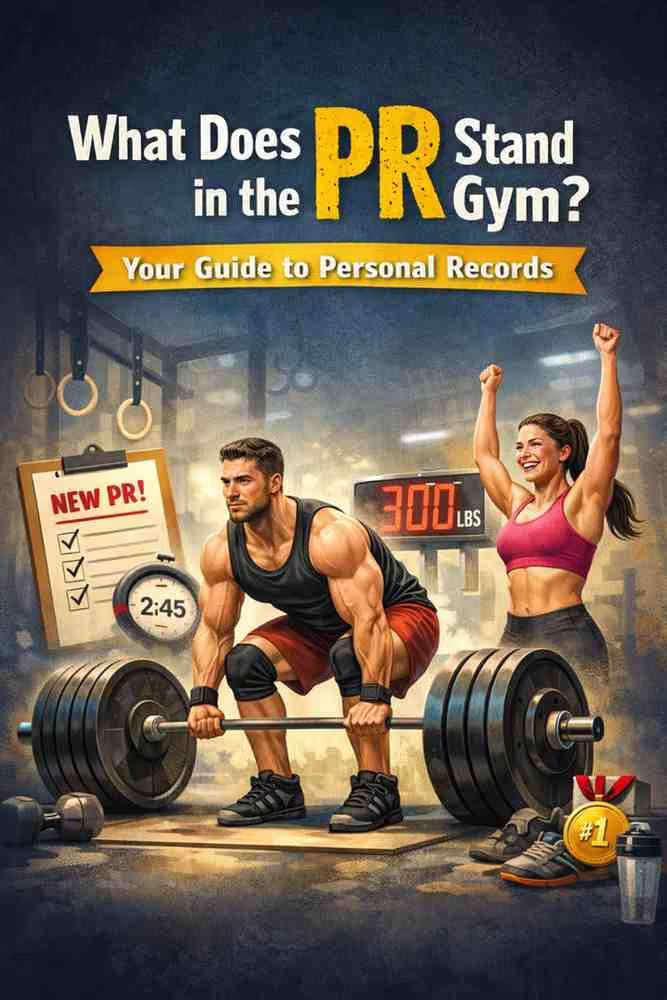
PR stands for personal record. It is your best-ever performance on a specific exercise, whether that is the heaviest weight you have lifted, the most reps you have completed at a given load, or your fastest time over a set distance. Any time you beat your own previous best, you have set a PR.
You may also hear it called a PB, or personal best. The two terms mean exactly the same thing. PR is more common in American gyms and powerlifting, PB in British English and running. Below are the five types of PR, how often you should actually test one, and how coaches use client PRs to set training loads..
Whether you're coaching clients or chasing your own goals, understanding personal records changes how you approach training. Here's everything you need to know.
{{gym-name-generator-form="/blog-gym-name-generator"}}
What Does PR Mean in the Gym?
PR means Personal Record. You might also hear it called PB (Personal Best)—the terms are interchangeable.
A gym PR represents your best-ever performance in a particular exercise or activity. In weightlifting, that's typically the heaviest weight you've lifted for a given exercise. But gym prs extend far beyond one-rep maxes.
Your PR could be the most you've ever squatted for a single rep. It could be the most reps you've completed with a certain weight. It could be your fastest mile or your longest plank hold.
The key word is personal. Personal records aren't about competing with others—they're about competing with your past self.
That 200-pound deadlift might be someone else's warm-up, but if it's the most weight you've ever lifted, it's your PR and it deserves recognition.
Building a Successful PR Strategy in Your Fitness Journey
Achieving new personal records requires more than just showing up to the gym it demands a strategic approach to your fitness routine. Understanding personal records and how they fit into your overall workout plan is crucial for long-term success.
When you spend time planning your pr attempts, you create opportunities for consistent effort that leads to measurable results. The key is to gradually increase intensity while maintaining proper form throughout each particular exercise.
Whether you're working toward your first unassisted pull up or increasing how much weight you can lift on a particular lift, remember that every small victory counts.
Mental fortitude plays a significant role in pr achieving you need to visualize success before attempting a new pr.
By combining adequate rest, quality sleep, and a structured program with the support of a supportive community, you set yourself up for optimal performance.
Don't let progress stalls discourage you; instead, view them as opportunities to reassess your training program and make necessary adjustments.
Remember, prs matter because they represent tangible proof of your self improvement and demonstrate that your consistent training is moving you in the right direction.
Every new record you set, no matter how small, is a testament to your dedication and a step forward in your fitness journey.
What Are the 5 Types of PRs in the Gym?
PRs come in several flavors. Understanding the different types helps you track progress across multiple dimensions of fitness.
Weight PR (1RM)
This is the classic PR most people think of. It's the heaviest weight lifted for a single repetition on a specific exercise.
Examples: Squatting 315 lbs for the first time. Deadlifting 405 lbs. Bench pressing your bodyweight.
Weight PRs are the gold standard for measuring maximal strength. They're exciting, motivating, and give you bragging rights in any gym conversation.
Rep PR
A rep PR is the most repetitions you've completed with a specific weight. This measures muscular endurance and work capacity.
Examples: Hitting 10 reps on bench press with 185 lbs when your previous best was 8. Doing 20 pull-ups when you could only manage 15 before.
Rep PRs are often safer to pursue than 1RM attempts and can be just as satisfying.
Volume PR
Volume PRs measure total work done in a session—sets × reps × weight. They're particularly relevant for hypertrophy-focused training.
Example: Completing 5 sets of 5 reps at 225 lbs on squat (5,625 lbs total volume) when your previous best session was 4 sets of 5 at the same weight (4,500 lbs).
Endurance PR
These track cardiovascular and stamina improvements your fastest time over a set distance, longest duration at a certain pace, or greatest distance covered.
Examples: Running a 7-minute mile. Rowing 2,000 meters in under 8 minutes. Completing a workout in less time than before. Achieving a new personal record with jump rope endurance.
Skill-Based PR
For functional fitness and gymnastics movements, PRs might track skill acquisition—your first unassisted pull up, first muscle up, or first handstand hold.
These milestones matter even without numbers attached.
💪 Got an idea for a brand? Let's bring it to life.
Launch your own fitness app with FitBudd in minutes!
💪 Got your brand name? Let’s bring it to life.
Launch your own fitness app with FitBudd in minutes!



88% trainers worldwide gave us 5 stars
Transform your fitness business with the power of your branded app on iOS and Android.
Try for FREEWhy PRs Matter for Progress
PRs serve several critical functions in a training program.
Tangible Evidence of Progress
Fitness improvements often feel invisible. The mirror lies. The scale fluctuates. But a PR doesn't lie. If you lifted more weight today than you did three months ago, you got stronger. Period.
This concrete feedback keeps you grounded when subjective feelings suggest otherwise.
Goal-Oriented Training
PRs give you something specific to chase. Instead of vaguely "getting stronger," you're working toward a 300-pound squat or a 10-rep bench press at a specific weight. These become pr goals that drive your fitness routine.
Clear targets focus your training and make programming decisions easier within your workout plan.
Motivation and Momentum
There's a reason gyms erupt when someone hits a new pr. It feels good. That dopamine hit creates positive associations with training and makes you want to come back.
Small improvements accumulated over time build confidence. Each one proves you're capable of more than you thought, contributing to your self improvement and mental fortitude.
Progress Monitoring for Coaches
For coaches, client PRs provide objective data points. If PRs are consistently improving, the program is working. If they're stagnant, something needs adjustment recovery, volume, intensity, or technique.
PR tracking cuts through the noise and shows what's actually happening, helping coaches guide clients in the right direction.
How Coaches Use PRs to Program Training
For coaches, a PR isn't just a milestone to celebrate. It's the number the whole training plan is built around.
Most structured programs prescribe load as a percentage of a recent max. If a client's best squat is 200 lbs, working sets at 75 percent means 150 lbs. Using a real, recent PR as the anchor keeps intensity accurate week to week, so clients train hard enough to progress without tipping into loads they can't handle safely.
Tracked over time, PRs also tell you whether the program is doing its job. Steady improvement means the plan is working. A stall usually points to recovery, volume, or technique, and tells you exactly what to adjust before the client loses momentum. That's the difference between guessing and coaching with data.
PR vs. 1RM: What's the Difference?
These terms often get used interchangeably, but there's a subtle distinction worth understanding.
1RM (One-Rep Max) refers specifically to the heaviest weight you can lift for a single repetition. It's a category of PR focused on maximal strength.
PR (Personal Record) is the broader term. Your 1RM is one type of PR, but you can also have rep PRs, volume PRs, and endurance PRs that don't involve one-rep maxes at all.
Additionally, some coaches distinguish between a tested 1RM (what you've actually lifted) and a calculated 1RM (estimated from rep performance). Your PR is always what you've actually done not what a calculator says you could do.
The practical takeaway: every 1RM is a PR, but not every PR is a 1RM.
How Often Should You Attempt a PR?
This is where many gym-goers go wrong. Chasing PRs every session sounds motivating, but it's a fast track to burnout, injury, and stalled progress.
For 1RM attempts: Most experts recommend testing true one-rep maxes only 2–3 times per year, typically at the end of a dedicated strength cycle. Professional powerlifters often only max out in competition.
For rep PRs and volume PRs: These can be pursued more frequently every 8–12 weeks is a reasonable target for most lifters.
For beginners: Novice lifters can set PRs more often because adaptation happens quickly. Testing every 8–10 weeks is reasonable during the early stages.
The reasoning? True max attempts are neurologically fatiguing, technique tends to break down under maximal loads, and the injury risk increases. The strength you build comes from weeks of sub-maximal training the PR attempt is just a demonstration of that strength.
A better approach: build strength through consistent training at 70–90% of your max, then periodically test to see where you stand.
How to Set and Break PRs Safely
Hitting PRs consistently requires smart strategy, not just max-effort attempts.
1. Follow a Structured Program
Random training produces random results. A well-designed program progressively increases load or volume over time, setting you up for PRs at strategic intervals.
Programs built around progressive overload adding small amounts of weight or reps each week create the conditions for PR success.
2. Prioritize Technique
Form matters more at heavy weights, not less. Poor technique under maximal loads is how injuries happen.
Before chasing weight PRs, ensure your form is solid at sub-maximal loads. Record your lifts. Get coaching feedback. Fix issues before they become problems.
3. Warm Up Properly
A good warm-up for a PR attempt might look like: bar only → 50% → 65% → 75% → 85% → 90% → PR attempt.
Keep warm-up reps low (1–3) as you approach your max to avoid accumulating fatigue.
4. Have Safety Measures
Use a spotter for bench press. Set safety pins in a power rack for squats. Never attempt a heavy single without a backup plan.
5. Choose the Right Day
Attempt PRs when you're well-rested, well-fed, and mentally ready. Sleep matters. Stress matters. Nutrition matters. Don't chase a PR after a bad week.
6. Start Conservative
Aim for a 5–10 lb PR on big lifts, not 50 lbs. Small, achievable PRs compound over time into massive strength gains. Getting greedy leads to missed attempts and frustration.
Tracking Your PRs
You can't improve what you don't measure. Every serious lifter should spend time keeping track of their PRs.
What to track:
- Exercise name
- Weight lifted or how much weight used
- How many reps completed
- Date achieved
- Any relevant notes (how it felt, technique observations, etc.)
How to track:
- Fitness apps with pr tracking features
- Simple spreadsheet
- Dedicated training journal
- Your coaching platform (if delivering programs to clients)
For coaches, tracking client PRs provides valuable data for program adjustments and gives clients tangible proof of their progress during check-ins. A supportive community can also help with accountability.
What to Do When Your PRs Stall
Every lifter eventually hits a plateau. When PRs stop coming, the fix is diagnosis, not panic. Work through these five checks in order, because the first two account for most stalls.
Check recovery. Are you sleeping enough? Eating enough protein? Managing stress? Recovery issues are the most common culprit when progress stalls.
Evaluate volume. You might need more training volume to drive adaptation—or you might be doing too much and accumulating fatigue.
Address weak points. If your squat is stuck, the limiting factor might be quad strength, hip mobility, or core stability. Identify and target the weak link in your particular lift.
Change the stimulus. Your body adapts to repeated stress. Varying rep ranges, exercise selection, or training style can spark new progress. Gradually increase the difficulty.
Be patient. As you get stronger, PRs come slower. A beginner might PR every week. An advanced lifter might work months for 5 pounds. This is normal on any fitness journey.
Visualize success. Mental preparation can help you push through plateaus and achieve your pr goals.
Helping clients track and celebrate their PRs keeps them motivated and coming back. A branded fitness app lets you log workouts, monitor progress, and make every PR visible, which turns small wins into long-term retention. See how FitBudd's client progress tracking helps coaches keep clients engaged.


Meet the author
Yangzey Sherpa
Frequently Asked Questions

Yangzey Sherpa leads content strategy at FitBudd, overseeing content planning and execution across fitness-focused digital channels. With over five years of experience in SEO and content, she works closely with the fitness industry to ensure content aligns with the needs of coaches, trainers, and gym owners. Her role keeps her deeply connected to fitness business workflows, coaching models, and how professionals use digital platforms to grow.


Apra Pathak has worked closely within the fitness niche for several years, supporting personal trainers and fitness coaches through content and digital marketing initiatives. Her experience centers on understanding how fitness professionals build visibility, communicate value, and engage clients online. Through sustained involvement with fitness-focused platforms and audiences, she has developed a strong understanding of the digital needs and growth challenges faced by modern fitness businesses.

Aishwarya Mehra has been actively involved in fitness-focused digital marketing, working closely with brands and platforms that serve coaches, trainers, and fitness businesses. Her experience spans engagement-driven strategies designed specifically for fitness audiences. Through ongoing exposure to fitness campaigns and communities, she remains closely aligned with how fitness professionals attract, convert, and retain clients in digital environments.

Suchandra Das has contributed content within the fitness niche, working on resources designed for coaches, trainers, and fitness business owners. Her experience involves supporting fitness-related topics with clear, structured, and accessible content. Through consistent involvement with fitness-focused platforms, she has developed familiarity with coaching workflows, client communication, and the informational needs of fitness professionals.
FitBudd is a fitness technology platform built exclusively for coaches, personal trainers, gym owners, and fitness professionals. The platform supports fitness businesses through branded apps, white-labeled solutions, and websites designed around real coaching and training workflows. FitBudd works closely with the global fitness community, maintaining deep, ongoing involvement in the fitness industry.

Ankit Uniyal has worked extensively with fitness-focused content, supporting platforms that cater to personal trainers, gym owners, and fitness professionals. His experience includes optimizing and structuring content around fitness-related search behavior and user intent. Through continued involvement in the fitness niche, he has gained a strong understanding of how trainers and coaches build discoverability and authority online.

Saumya Mittal is the Co-Founder and CEO of FitBudd. Since 2021, she has been actively engaged in the fitness technology sector, collaborating with global fitness companies to foster digital growth and scalable operations. With over a decade of experience leading high-impact projects in engineering and operations, Saumya has a strong background in developing reliable and scalable systems. Through FitBudd, she is dedicated to addressing the evolving needs of fitness professionals worldwide.

Kinshuk Snehi has been closely involved in the fitness space for over four years. Through his work at FitBudd, he has contributed to shaping how fitness professionals build their online presence, attract clients, and scale sustainable coaching businesses. Deeply interested in the intersection of fitness, technology, and growth, Kinshuk brings a hands-on understanding of the challenges faced by modern trainers. His passion lies in building systems and strategies that support long-term consistency, both in fitness journeys and business growth.

Kanika Verma has been closely involved in building solutions for the fitness industry, working with platforms used by coaches and trainers globally. Her experience includes direct exposure to fitness coaching workflows and operational needs. Through sustained involvement in fitness-focused product development, she has developed a strong understanding of how fitness professionals manage clients, programs, and daily operations.

Tanya Sharma has worked on branding initiatives within the fitness niche, supporting fitness platforms and businesses with visual identity design. Her experience includes creating brand systems used by coaches, trainers, and fitness-focused products. Through ongoing involvement in fitness-related design projects, she remains closely connected to how fitness brands communicate trust and professionalism.

Niharika Sonavane has contributed to visual design projects within the fitness industry, supporting platforms and brands serving fitness professionals. Her experience spans creating digital assets used across fitness apps, websites, and marketing materials. Through continued work in the fitness niche, she remains closely aligned with the visual communication needs of coaches and fitness businesses.

Elesh Patel has worked extensively on marketing initiatives within the fitness niche, managing paid campaigns for fitness-focused products and services. His experience includes supporting platforms that target personal trainers, gym owners, and fitness creators. Through long-term involvement in fitness marketing, he remains closely connected to how fitness professionals discover and adopt digital tools.

Ultimate Marketing Guide for Fitness Trainers
Boost your business growth with these tried and tested marketing strategies. Free for you to download.
Download Now
Templates
These functional templates have the power to make any fitness trainer's life easier.
Subscribe To
Our Blog
.avif)